
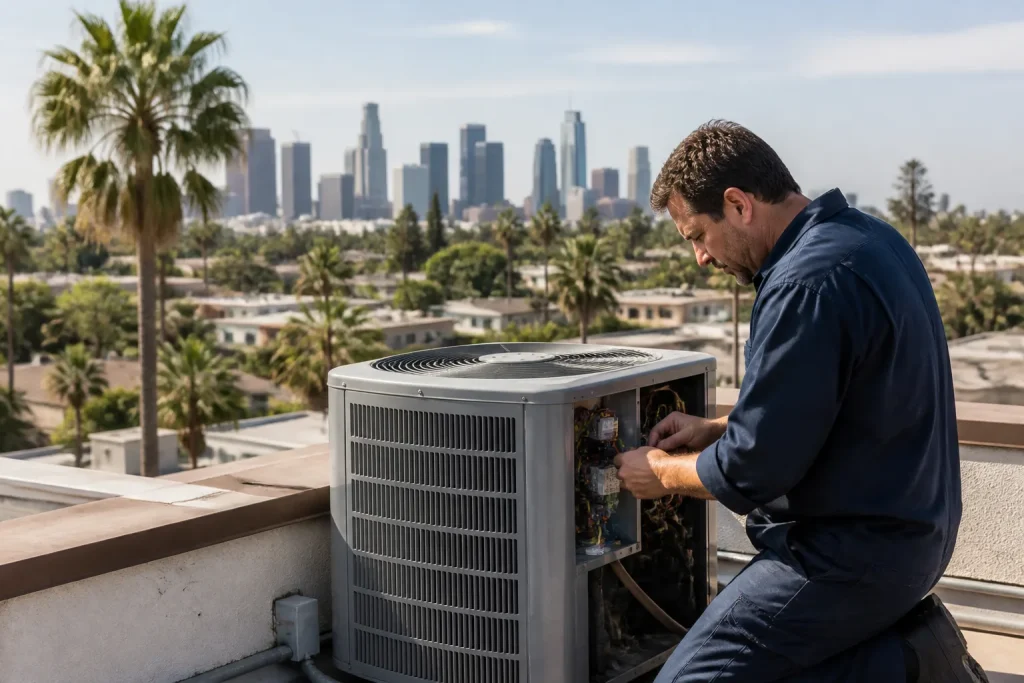
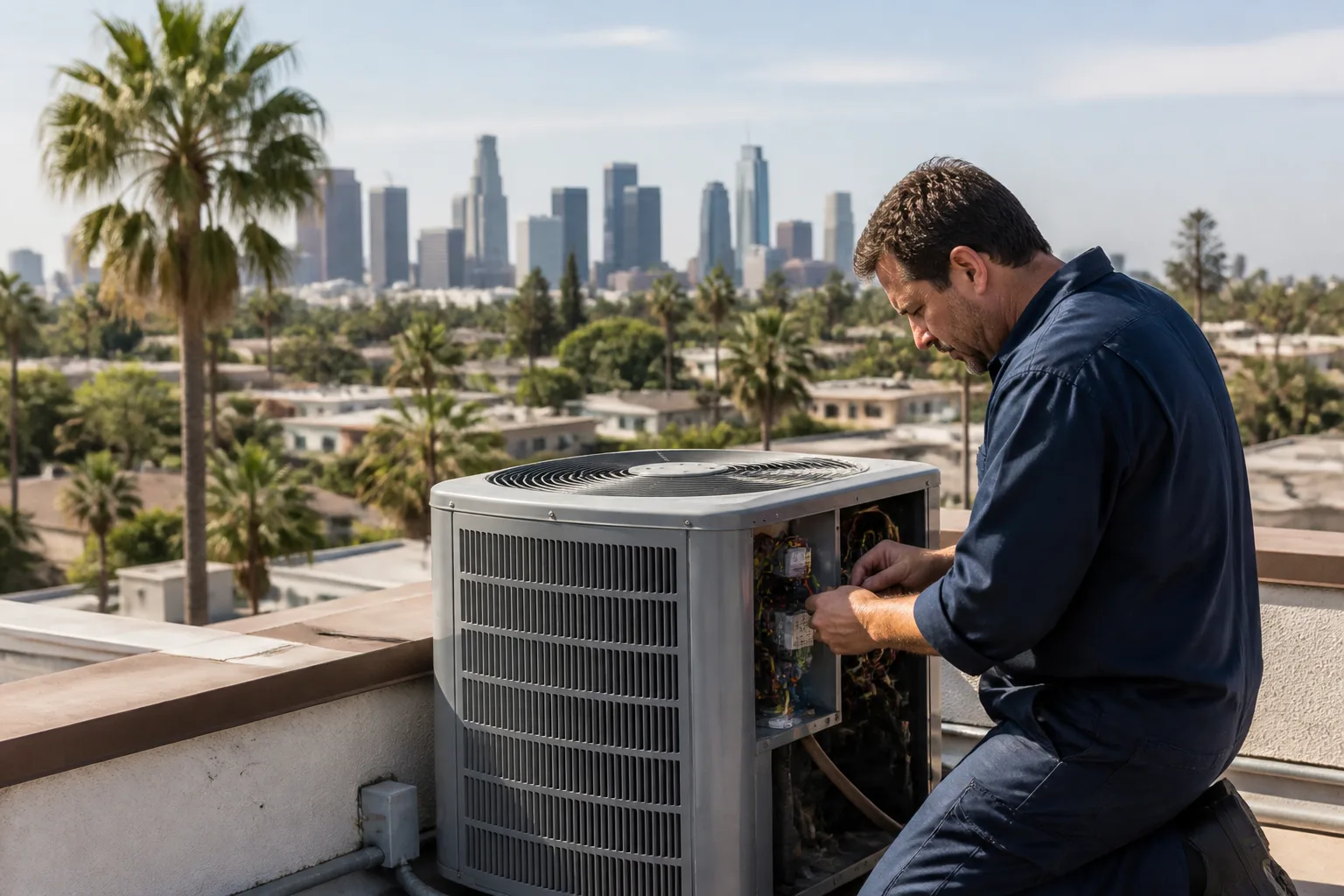
Carrier AC Repair in Los Angeles: A Homeowner’s Guide
Carrier AC repair in Los Angeles typically costs between $180 and $850 depending on the part. The most common issue we see is misdiagnosis: technicians who treat Carrier’s communicating systems like old-school mechanical units end up replacing expensive parts when the real fix is a calibration or wiring correction. If you’d rather not sort through fault codes yourself, call (984) 538-9003 and we’ll put a written price in front of you before any work starts.
Carrier’s Infinity and Performance series air conditioners are everywhere in Los Angeles. Walk through neighborhoods like Encino, Sherman Oaks, or Silver Lake and you’ll spot the familiar Carrier condensers humming beside homes. That popularity creates a specific problem: because these units are so common, every technician claims to know them. Few actually understand the way Carrier’s communicating systems work, and that gap shows up as wrong diagnoses and wasted money.
Why Carrier’s Communicating System Is Different (And Why That Matters for Repairs)
Most AC systems are simple. The thermostat sends a 24-volt signal, the condenser turns on, and the blower follows. Carrier’s Infinity and higher-end Performance series changed that game. In a communicating system, the thermostat, air handler, and condenser share data through a digital language. They report temperatures, pressures, error codes, and operational history to each other. When something goes wrong, the system usually knows what it is before the technician does.
The catch: the technician has to understand Carrier’s fault code language. A communicating system that throws a fault code isn’t necessarily telling you a part died. Often it’s flagging a communication error, a calibration drift, or a wiring issue between components. We’ve walked into homes in West Los Angeles where another company had quoted a full condenser replacement, only to find a loose four-wire connection at the control board. The fix took 20 minutes.
Here’s what a Carrier-specific diagnostic should include:
- Fault code history: A proper Carrier diagnostic pulls stored codes, not just active ones. Past codes tell you whether a problem is recurring or isolated.
- Refrigerant pressure readings: Both high and low side, compared against Carrier’s published specs for that exact model and outdoor temperature.
- Electrical measurements: Capacitor microfarad readings, contactor resistance, and amp draws on the compressor and fan motor.
- Communication verification: The technician should confirm the thermostat, air handler, and condenser are talking properly across the data lines.
If your previous technician handed you a report that says “system checked” or “unit running fine” with no numbers attached, you didn’t get a Carrier diagnostic. You got a visual once-over. That’s the misdiagnosis trap in Los Angeles, and it’s the single biggest reason Carrier owners end up paying for repairs they never needed.
The Three Most Common Carrier Repairs We See in Los Angeles
We work on Carrier units every week across Los Angeles. Three issues dominate the call log, and each has its own pattern. Knowing these helps you understand what you’re looking at before a technician even arrives.
1. Infinity Control Board Faults
The Infinity control board is the brain of a communicating Carrier system. In coastal Los Angeles neighborhoods like Playa del Rey or Marina del Rey, salt air accelerates corrosion on board connections. In inland areas like Woodland Hills or Burbank, heat cycles stress the board’s solder joints over time. When the board fails, the system may stop responding to the thermostat entirely, or it may throw communication errors that look like something else.
A board replacement on an Infinity system generally runs $400 to $700 parts and labor, depending on the model. But here’s the inflection point: if your unit is 12 to 15 years old and the board has failed, the board rarely fails alone. Other components are often close behind. We tell homeowners straight: replacing a board on an aging Carrier is sometimes throwing money into a system that’s entering its end-of-life years. We’ll say more on that below.
2. Performance Series Capacitor Failures
Carrier’s Performance series is a workhorse line, and its capacitors take a beating in Los Angeles heat. A capacitor provides the electrical jolt that starts the compressor and fan motor. When it fails, you’ll hear a hum from the condenser but the fan won’t spin, or the whole unit just sits there silent on a 95-degree day.
Capacitor replacement on a Performance series unit typically costs $150 to $300 including the part and labor. It’s one of the most affordable Carrier repairs, and it’s also one of the most commonly misdiagnosed. A technician who doesn’t test the capacitor’s microfarad rating under load may tell you the compressor is dead. A new compressor runs $1,800 to $3,500. That’s a brutal misdiagnosis on a $250 fix. Ask for the capacitor reading before you approve any compressor work.
3. Refrigerant Issues in Aging R-22 Units
Carrier units manufactured before 2010 likely run on R-22 refrigerant. R-22 production was phased out in the United States as of 2020. What that means in practical terms: refrigerant that used to cost $40 per pound now runs $150 to $250 per pound in Los Angeles, and it’s only getting scarcer. If your aging Carrier has developed a slow leak, recharging it every summer becomes a losing financial game.
A refrigerant recharge on an R-22 Carrier typically runs $300 to $800 depending on how much refrigerant the system needs. If your unit needs more than a couple pounds, or if you’re recharging it annually, you’re crossing into replacement territory. We never recommend a fourth R-22 recharge. By that point, the money you’ve spent on refrigerant would have covered a meaningful chunk of a new system.
Understanding Carrier’s Warranty Tiers: What’s Covered and What Voids It
Carrier’s warranty structure matters in Los Angeles because our climate runs systems hard. Here’s the plain-language version of how the tiers work.
Base warranty: Every Carrier unit leaves the factory with a 5-year parts warranty. If the compressor fails in year three, the part is covered. Labor is not. You need a licensed contractor to perform the work, and Carrier requires proof of installation by that licensed contractor.
Registered warranty: If you registered the unit with Carrier within 90 days of installation, the parts warranty extends to 10 years on most components. This is the most common status for Los Angeles homes built or retrofitted in the last decade. If you’re not sure whether your unit was registered, you can check the serial number on Carrier’s website or have a technician pull it during a diagnostic.
Extended labor warranty: Some dealers sell a labor warranty add-on that covers the cost of repair labor beyond the standard parts-only coverage. These are purchased policies, and terms vary widely by provider.
What voids a Carrier warranty? Three things, consistently: installation by an unlicensed contractor, use of non-Carrier replacement parts, and failure to document annual maintenance. That last one catches Los Angeles homeowners more than you’d expect. Carrier can require maintenance records when you file a major claim. If you haven’t had the system serviced in five years, a compressor claim may get denied.
Whenever we repair a Carrier in Los Angeles, we document the repair with the same detail Carrier asks for on warranty claims. Part numbers, serial numbers, refrigerant readings, and photographs. That paper trail is what keeps your coverage alive.
What a Carrier Diagnostic Report Should Actually Show
Every Carrier repair should start with a diagnostic you can hold in your hand and read. Not a verbal “looks fine to me.” A written report with numbers. If a company refuses to show you the diagnostic before quoting the repair, that’s your cue to get a second opinion.
A proper Carrier diagnostic report includes:
- Active and stored fault codes: With the plain-English explanation of what each code means, not just the number.
- Refrigerant pressure readings: High side and low side, both static and running.
- Temperature differential: The difference between supply air and return air at the indoor unit. A healthy Carrier system should show roughly 18 to 22 degrees of drop.
- Capacitor and contactor readings: Measured values with the acceptable range listed beside them.
- Amp draw on the compressor and fan motor: Compared against Carrier’s factory spec for your exact model.
We’ve been called to fix Carrier units in Los Angeles after other companies produced two-word diagnostic summaries. The homeowner was given a replacement quote and told the system was unsalvageable. Then we pulled the codes and found a clogged condensate drain tripping a safety switch. A $189 repair instead of a $12,000 replacement.
That’s why we insist on written diagnostics and a written price before any work starts. You should see exactly what the system is telling us and exactly what each repair option costs. Not an estimate after the fact. Not a surprise when the invoice arrives.
Repair or Replace: The Honest Inflection Points for Carrier Units in Los Angeles
Nobody wants to hear they need a new AC. We don’t want to tell you that unless the math is clear. But there are times when repairing a Carrier in Los Angeles is just delaying a decision that’s already been made for you.
Here are the inflection points where we tell homeowners to seriously consider replacement:
- Control board failure on a 12+ year old unit: As mentioned earlier, the board rarely fails in isolation at that age. Compressor, condenser fan motor, contactor, refrigerant leaks – the list of upcoming repairs starts stacking. A $600 board today often means a $900 compressor next summer.
- Third R-22 refrigerant recharge: If you’ve added refrigerant twice and it’s low again, you have a leak that’s worth finding and fixing or a system that’s ready for retirement. Spending $800 per year on R-22 for a unit on its last legs doesn’t pencil out.
- Compressor failure outside the warranty period: A Carrier compressor replacement runs $1,800 to $3,500. If your unit is 12 to 15 years old, that’s often half or more of a new system’s cost, and you’re still left with an aging coil, aging controls, and a system with no remaining warranty cushion.
- Any repair exceeding $2,000 on a unit older than 10 years: This is the general threshold we use. Once a single repair crosses that line, replacement math gets hard to argue against, especially with current rebate programs through utilities like LADWP.
Of course, the decision isn’t always about cost alone. Los Angeles summer heat creates real health risks, especially for young children and older adults living in the San Fernando Valley where temperatures routinely exceed 100 degrees. A system that fails in August and takes three weeks to repair isn’t just uncomfortable. That’s why we stock common Carrier replacement parts in our Los Angeles service vehicles and run emergency repair appointments through the hottest months.
When to Call a Pro for Carrier AC Repair in Los Angeles
Some AC issues are easy to check yourself. A tripped breaker, a dirty filter, a thermostat with dead batteries. Those are homeowner-level fixes. But Carrier’s communicating systems add a layer of complexity that makes DIY diagnosis genuinely risky. High-voltage electrical work, refrigerant handling, and control board replacement all require a licensed technician who knows Carrier’s architecture. Attempting these without training can cause injury and void your warranty at the same time.
If you’re seeing a fault code on an Infinity thermostat, hearing a hum from the condenser with no fan movement, or noticing your system cycling on and off without reaching the set temperature, that’s a call for a professional evaluation. Our technicians are background-checked and identity-verified under the Brandt HVAC home Threshold Verified standard, and we’ll send you the technician’s name and photo before they arrive so you know exactly who’s walking up to your door.
For more on our general repair services in the area, see our AC Repair in Los Angeles page. If your furnace needs attention too, we handle Furnace Repair in Los Angeles with the same Carrier-specific approach. And if you’d rather prevent a repair than pay for one, our AC Maintenance in Los Angeles tune-ups include a written report with the same diagnostic detail we’d provide during a repair.
The Bottom Line
Carrier makes a genuinely smart air conditioner, and its communicating systems give homeowners in Los Angeles a real advantage: the equipment often knows what’s wrong before anyone else does. But that advantage only pays off if the technician holding the diagnostic tool can read what the system is saying. Misdiagnosis is the most expensive mistake in Carrier repair, and it happens far more often than it should.
Here’s what to remember: ask for fault code history and measured readings in writing. Get the diagnostic before you approve the repair. Verify your Carrier warranty registration status. And when a repair quote doesn’t make sense, get a second opinion from someone who works with Carrier systems specifically.
If you’re in Los Angeles and need a Carrier diagnosed, a repair quoted, or just a straight answer about whether to fix or replace, Brandt HVAC offers free estimates with a written price before any work starts. Call (984) 538-9003 and you’ll talk to a live person, any hour, any day.
Frequently Asked Questions
Most Carrier AC repairs in Los Angeles run between $180 and $850. Simple fixes like capacitor replacement typically cost $150 to $300, while control board replacement on an Infinity system runs $400 to $700. Refrigerant recharge on an older R-22 unit can run $300 to $800. Every job gets a written price before work starts. Call (984) 538-9003 for an exact quote on your system.
Fault codes on a Carrier Infinity system often point to communication errors, not hardware failure. Loose wiring, corroded connections, or calibration drift can trigger codes that make it look like a component died. A proper diagnostic pulls stored code history and measures electrical readings before recommending any part replacement. If you’ve been quoted a major repair based on a code alone, get a second look.
Replace it if the unit is more than 12 years old and facing a major repair like a compressor or control board, if you’ve recharged R-22 refrigerant three times or more, or if any single repair exceeds $2,000 on a system older than 10 years. Repair it if the unit is under 10 years old, the part is covered by warranty, and the repair is isolated to a single component. We’ll give you a straight answer either way, with numbers to back it up.
Yes. We service Carrier systems across Los Angeles, including the San Fernando Valley, the Westside, and coastal neighborhoods. Our technicians work with Infinity and Performance series units regularly, and we stock common Carrier parts locally for faster repairs. We also service Rheem, Goodman, and Daikin equipment, so we can help if you have a mixed system.
Written by the team at Brandt HVAC.
Need HVAC Help?
Call Brandt HVAC - licensed & insured, here with fast after-hours help in Los Angeles.
(984) 538-9003